
Latest News
Housing Market Sees “Falling Transactions and Rising Prices”: A New Phase Revealed by 2025 Data
2026/3/11
Market Forecast Column

Japan’s Real Estate Market Enters a Phase of “Lower Transactions but Rising Prices”
According to real estate statistics released in November 2025, Japan’s housing market showed a distinctive trend: transaction volumes decreased while prices continued to rise. The Existing Home Sales Index indicates that transactions declined nationwide, while the Real Estate Price Index shows that housing prices increased. As a result, the market is experiencing a situation where “declining transaction volumes” and “rising prices” are occurring simultaneously. This phenomenon is believed to be the result of multiple factors, including changes in the interest rate environment, concentrated demand in urban areas, and rising construction costs, suggesting that the real estate market may be entering a new phase.
First, looking at the Existing Home Sales Index published by Japan’s Ministry of Land, Infrastructure, Transport and Tourism (MLIT), transactions declined nationwide in November 2025. The national seasonally adjusted index fell to 125.8, representing a significant drop from the previous month. A similar trend was observed even when excluding homes smaller than 30 square meters, confirming a slowdown in transactions across the overall housing market.
Housing Transaction Volume Declined Nationwide
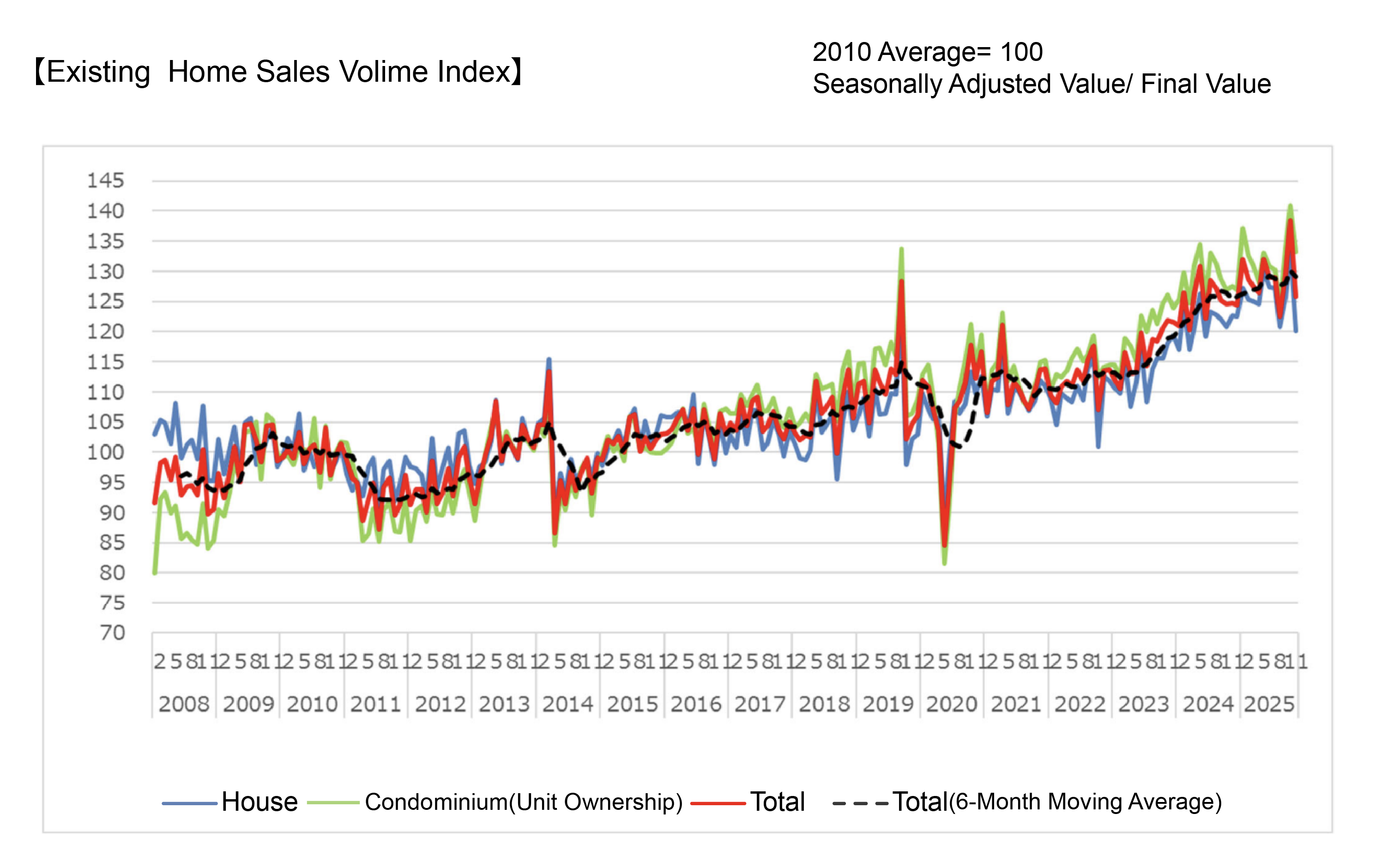
According to Japan’s Ministry of Land, Infrastructure, Transport and Tourism (MLIT), the Existing Home Sales Index fell significantly in November 2025.
National figures:
Total: 125.8 (down 9.1% from the previous month)
Excluding homes under 30㎡: 113.8 (down 9.9%)
Detached houses: 120.2 (down 10.1%)
Condominiums (over 30㎡): 106.9 (down 7.5%)
Detached house transactions declined more sharply, possibly due to expectations of rising mortgage interest rates and high housing prices.
Meanwhile, condominium transactions fell more moderately, suggesting that demand for urban housing remains relatively strong.
Looking at the data by region, a decline in transaction volumes was also observed in major metropolitan areas. In the Kanto region, overall transactions decreased moderately, but detached houses experienced a relatively larger decline.
Kanto Region
Total: 130.2 (down 5.4%)
Detached houses: 125.6 (down 9.5%)
Condominiums: 132.4 (down 4.1%)
Instead, the Kansai region recorded a larger decline than the Kanto region, suggesting that the housing market there has entered a somewhat stronger adjustment phase in transaction activity.
Kansai Region
Total: 128.1 (down 9.8%)
Detached houses: 106.7 (down 12.3%)
Condominiums: 148.7 (down 8.1%)
A city-level analysis shows that transaction activity decreased in both Tokyo and Osaka. In Tokyo, the condominium index continues to remain elevated, although overall transaction activity has moderated slightly.
Tokyo and Osaka
Tokyo
Total: 147.9 (down 4.8%)
Detached houses: 114.1 (down 7.3%)
Condominiums: 155.8 (down 4.0%)
Condominiums (excluding units under 30㎡): 117.1 (down 6.7%)
In Osaka, the decrease was even larger, with the detached house index falling below the 100 level.
Osaka
Total: 138.9 (down 10.8%)
Detached houses: 98.2 (down 12.2%)
Condominiums: 171.7 (down 9.5%)
Condominiums (excluding units under 30㎡): 104.6(down 8.8%)
Meanwhile, price movements tell a different story. The Real Estate Price Index shows continued growth in housing prices, suggesting that the Japanese housing market is still experiencing rising asset values.
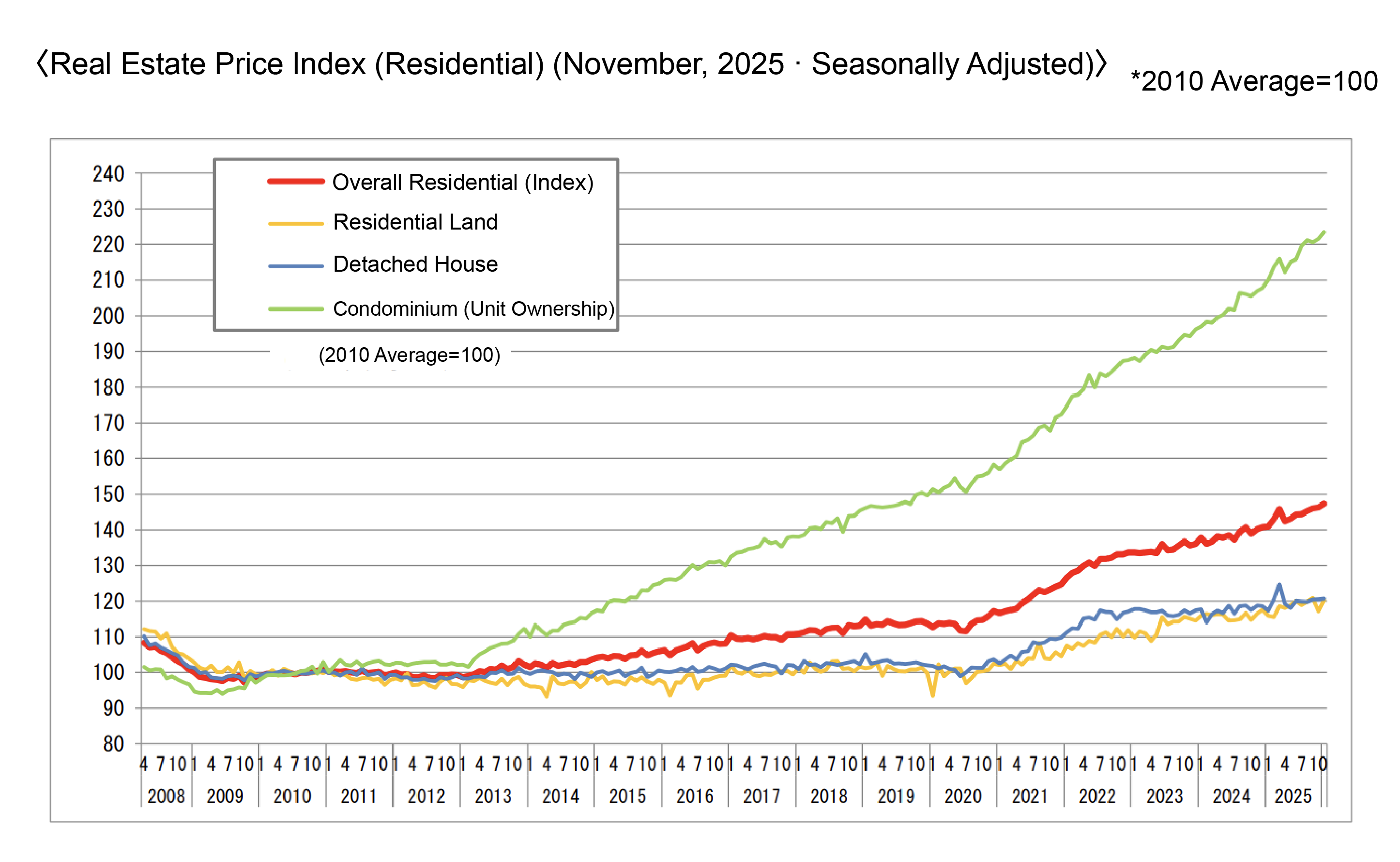
National Real Estate Price Index:
Housing overall: 147.3 (up 0.7%)
Residential land: 120.3 (up 2.6%)
Detached houses: 120.8 (up 0.2%)
Condominiums: 223.5 (up 0.8%)
In particular, the condominium price index has risen well above the 200 level, indicating that housing prices in urban areas continue to increase. Rising construction costs and a shortage of new housing supply are believed to be pushing up prices for existing condominiums.
By region, housing prices in the Kanto region increased moderately.
The Housing Price Index for the Kanto region is as follows:
Housing overall: 155.1 (up 0.8%)
Residential land: 128.0 (up 2.9%)
Detached houses: 124.2 (up 1.5%)
Condominiums: 217.2 (up 0.2%)
In Tokyo, the increase in housing prices was particularly notable.
The Housing Price Index for Tokyo is as follows:
Housing overall: 187.6 (up 5.8%)
Residential land: 153.8 (up 14.4%)
Detached houses: 144.4 (up 3.8%)
Condominiums: 237.0 (up 1.9%)
The more than 14% surge in residential land prices likely reflects the strong influence of urban redevelopment and ongoing population concentration.
Commercial Real Estate Trends
Commercial real estate prices show mixed trends.

Commercial property overall: 147.2 (up 1.1%)
Retail: 169.5 (up 3.4%)
Office: 168.5 (down 5.9%)
Residential buildings (apartment blocks): 173.7 (up 0.7%)
In Japan’s three major metropolitan areas, logistics facilities showed strong growth:
Warehouses: 153.6 (up 16.1%)
The growth is likely supported by the expansion of e-commerce and the development of logistics infrastructure. In contrast, the office market has entered a period of price adjustment amid changes in working patterns.
At the same time, corporate real estate transactions have temporarily declined, with the Corporate Transaction Volume Index indicating a more cautious stance among investors in the short term.
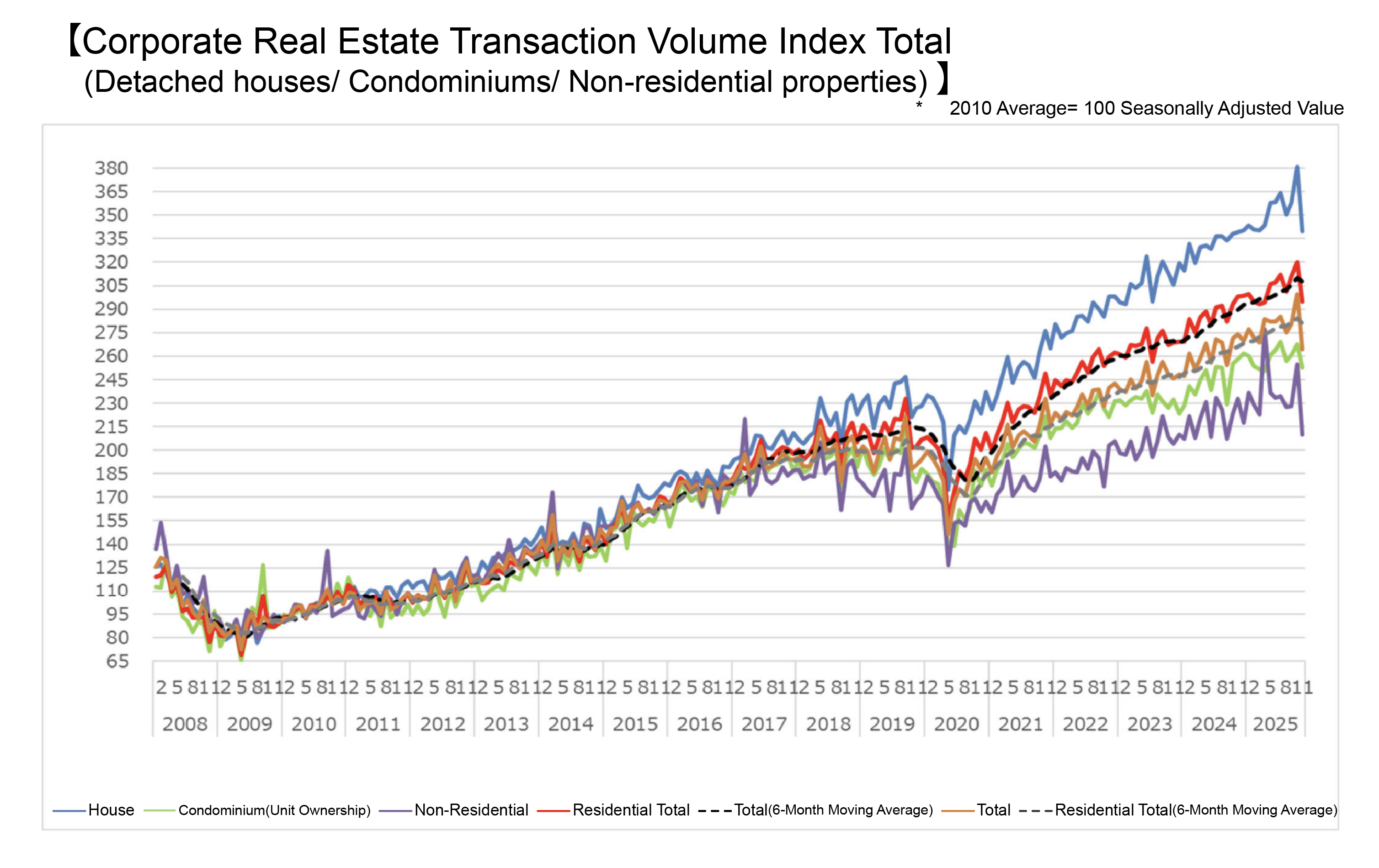
Corporate transaction index:
Total: 264.4 (down 11.8%)
Housing: 295.0 (down 7.9%)
Detached houses: 339.6 (down 10.9%)
Condominiums: 252.8 (down 5.5%)
Non-residential: 209.8 (down 17.6%)
Based on these statistics, Japan’s real estate market appears to have entered a phase in which transaction volumes are declining while prices continue to rise. In general, when financial conditions change in real estate markets, transaction volumes tend to decline first, followed by price adjustments. However, in Japan, structural factors such as rising construction costs, population concentration in urban areas, and housing supply shortages suggest that a significant short-term decline in prices is unlikely.
Looking ahead to 2026, transaction volumes may remain flat or decline slightly in the near term, while prices are likely to maintain a gradual upward trend. In particular, demand for high-quality condominiums in major urban areas such as Tokyo and Osaka is expected to remain strong.
For investors, it is important not to rely solely on surface yields when making investment decisions. In a rising price environment, greater emphasis should be placed on asset value growth and the long-term potential of a location rather than on apparent yield alone. Moreover, as the gap between regions with declining populations and major urban centers continues to widen, selecting high-quality assets in urban areas is likely to play a decisive role in long-term investment performance.
These statistics suggest that Japan’s real estate market may be approaching a major turning point. Rather than focusing only on declining transaction volumes, it will become increasingly important to analyze price trends, financial conditions, and demographic changes comprehensively when evaluating future real estate investments.
For more information